Mirr Enterprise
Put AI to work across the organization without giving up control or accountability.
Mirr Enterprise bundles the coding agent, the execution control layer, and audit evidence into one enterprise agreement. It sits on top of your identity, repositories, internal tools, and private models, then scales department by department.
Review Mirr Enterprise- Confirm the identity of the person or agent and the authority delegated to it.
- Classify the request data and determine its permitted movement boundary.
- Select only models, tools, and execution locations allowed by current policy.
- Obtain required human approval and execute through the approved path.
- Preserve an evidence receipt linking the policy decision to the execution result.
This is not about adding another tool. It is about setting one operating standard.
As teams adopt different SaaS tools, APIs, internal models, and agent frameworks, security teams are left reconstructing who used which model, what data crossed a boundary, and which tool caused an action. Separate consoles and logs do not create a single chain of responsibility.
Mirr Enterprise bundles the coding agent, the execution control layer, and audit evidence into one enterprise agreement. Your identity, repositories, internal tools, and private models stay where they are, with one policy and evidence system above them. Department and workload differences are expressed as policy, while the control model stays consistent across the organization.
Before an employee asks AI to summarize a customer contract, the organization has questions to answer.
“Summarize the termination terms and risk clauses in this agreement, then add them to the legal review document.”
- 01Confirm actor and purpose
Resolve the employee and the acting agent, organization, and role from your enterprise identity, along with current work context.
- 02Determine the data boundary
Use document classification, residency requirements, and external-transfer rules as policy inputs.
- 03Select allowed models and tools
Let the server expose only policy-valid choices instead of trusting a client-selected endpoint.
- 04Place and execute
Route through the approved private environment and internal tools, pausing for additional human authorization when required.
- 05Preserve evidence
Record who allowed or denied the path, on what basis, and what the execution produced.
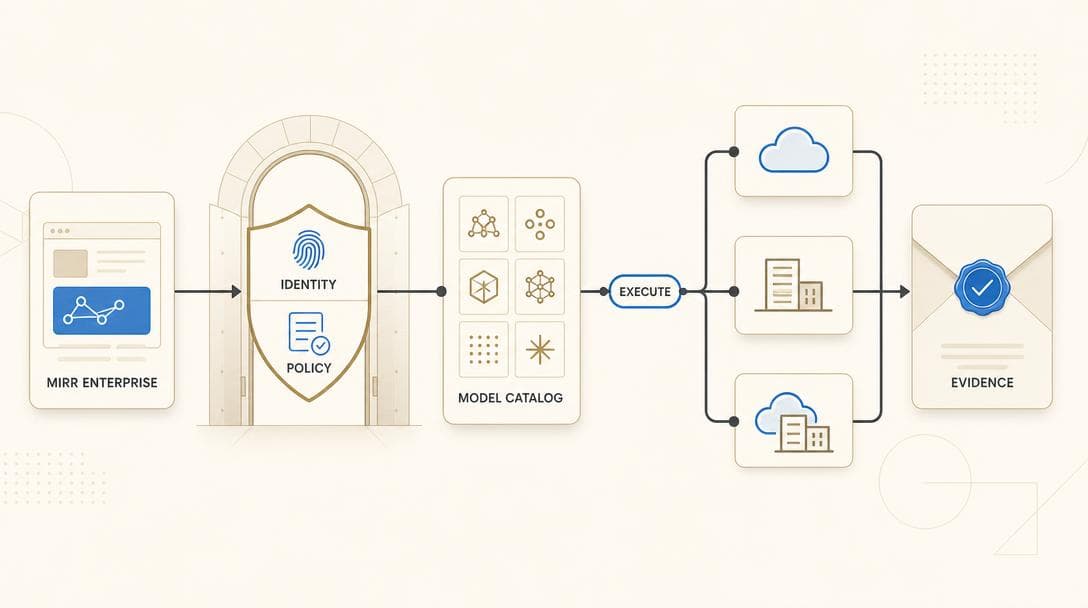
Visibility, enforcement, placement, and evidence no longer live in separate products.
Policy before execution
Evaluate DLP, classification, user and agent authority, model policy, and tool policy in the request path, with an operational denial reason.
Connection to existing systems
Keep your SSO and identity, repositories, issue trackers, and data platforms, and connect them through MCP and adapters. Adoption does not require replacing the way teams already work.
A server-authoritative catalog
The server computes currently permitted models and tools instead of accepting arbitrary names or endpoints from clients. Private and approved external models sit in the same catalog.
One investigable execution chain
Security, audit, and incident teams can connect identity, authorization, policy decision, execution, and outcome.
What Mirr Enterprise decides before an AI request meets infrastructure.
Mirr Enterprise is more than a proxy: one authoritative path decides whether to run, where to run, and what evidence to retain.
- 01SSO · tenant · actor
Establish identity
Connect the person, service account, or agent to enterprise identity and establish the responsible actor.
- 02grant · policy · DLP
Compute authority and policy
Evaluate delegated scope, data class, purpose, tools, time, and environment together.
- 03catalog · placement · scheduler
Select model and placement
Choose a private or approved external model, tool, and location from the allowed catalog.
- 04inference adapter · tools
Execute through the approved path
Use the official execution path without a separate fallback that bypasses control semantics.
- 05decision · result · receipt
Link decision and result
Retain allow or deny reasoning, model and tool execution, result, error, and approval evidence.
Deploy Mirr Enterprise where your data and systems already are.
These are deployment options, not claims of certification. Configuration follows your network and model placement.
Private cloud · VPC
Operate private models and approved external services inside your dedicated network.
- Enterprise IdP and policy
- Private adapters and storage
- Department and workload isolation
On-premises
Keep inference and execution inside your GPUs, storage, and internal systems.
- Internal model endpoints
- Repository and tool connections
- External transfer blocked
Hybrid
Split sensitive and general workloads across on-premises and cloud under one policy.
- Workload placement policy
- Consistent authority and approval
- Central evidence collection
The connection between decision and execution matters more than log volume.
Evidence is part of the result. Retention and field coverage are confirmed against organizational requirements during evaluation.
- Actor
- Human, service, and agent identity, enterprise identity linkage, and the on-behalf-of relationship
- Authority
- Delegation scope, policy version, decision, and rationale
- Data
- Classification, boundary, residency or transfer condition, and DLP decision
- Execution
- Model, tool, adapter version, placement, and scheduling result
- Outcome
- Success or failure state, error, approval history, and receipt linkage
Design principles for teams evaluating the control plane.
Mirr Enterprise is defined by operating invariants, not an inflated feature list.
Server-authoritative discovery
Available models and tools are computed from identity and policy; unknown client-selected targets cannot bypass the path.
One official path
A separate fallback that looks normal can blur control semantics. Keep one official AI data path, and do not silently route around policy when it is unavailable.
One codebase, different policies and topology
Apply policy and topology to the same kernel across departments, workloads, and environments instead of splitting the control model into per-environment products.
A compliance view for Korean regulation
Track control items and evidence status for CSAP, ISMS-P, the Personal Information Protection Act, and the AI Framework Act and ISO 42001 in one view. This is a mapping capability; certification is the customer organization’s process.
Follow one AI request through your organization from beginning to end.
We will map the actor, agent, data class, allowed models, deployment boundary, and evidence obligations into a concrete Mirr Enterprise adoption scope.